
.jpg)
.jpg)
Preservation Through Contemporary Design
The Coach House replaces a neglected post-war garage site with a carefully crafted contemporary dwelling within the North Oxford Victorian Suburb Conservation Area. Led by Robin Swailes Design & Development, the project evolved over several years through close collaboration with TSH Architects, planning consultant Nik Lyzba, Oxford City Council planners and the Council's conservation team.
The ambition was never simply to secure planning permission. The objective was to create a contemporary building that would enhance its setting, contribute positively to the character of North Oxford and demonstrate how new architecture can sit comfortably within a historic environment.
Design Through Dialogue
The original planning concept prepared by TSH Architects established the principle of development on the site. Working alongside planning consultant Nik Lyzba, Robin Swailes Design & Development continued to develop and refine the scheme through extensive engagement with planning officers, conservation specialists and neighbouring residents. Throughout this process, roof forms were redesigned, massing reduced, landscape proposals strengthened and architectural details refined. Following discussions with local residents, the principal kitchen was relocated from the prominent south-facing gable to the quieter northern side of the building. The completed building is therefore the outcome of a genuine collaborative effort focused on achieving the best possible outcome for this sensitive site.
Craftsmanship, Light & Proportion
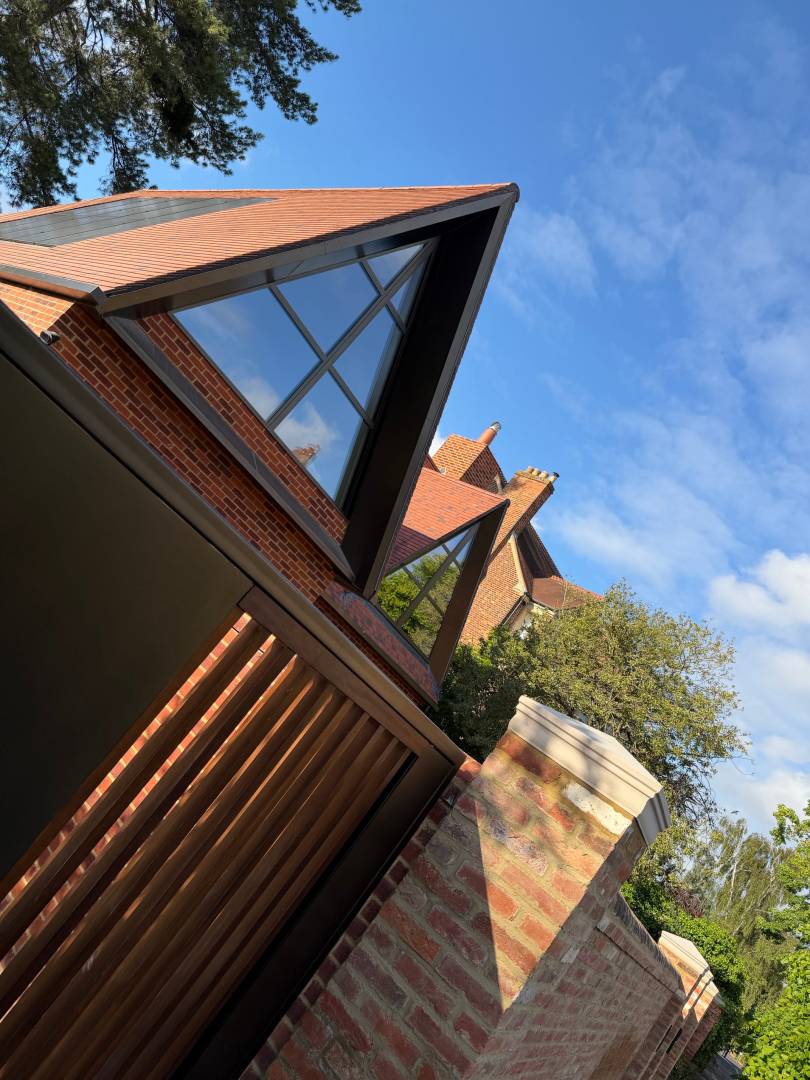
The defining architectural feature of the project is the pair of glazed triangular gables. Their geometry reflects the steep roofscape found throughout North Oxford while expressing those forms through a contemporary architectural language. Large aluminium-framed glazed openings maximise daylight from the building's southerly aspect, allowing sunlight to penetrate deep into the principal living spaces throughout the day.
The dark aluminium surrounds create crisp shadow lines and visual depth, emphasising balanced proportions and reinforcing the clarity of the overall architectural composition. Generous ceiling heights take inspiration from the surrounding Victorian houses, creating a sense of volume, light and permanence rarely achieved within a contemporary infill development.
.jpg)
Craftsmanship & Construction Quality
A fundamental objective of the project was that the quality of construction should match the quality of the design. Robin Swailes Design & Development deliberately selected Oxfordshire Brickwork as principal masonry contractor, recognising their reputation for delivering exceptional workmanship on architecturally sensitive projects throughout Oxfordshire.
Particular care was taken in the setting out of elevations, the consistency of coursing, the detailing of openings and the execution of the boundary walls, gate piers and chimney. The resulting masonry exhibits precision, discipline and architectural restraint, contributing significantly to the building's enduring character.
Sustainability & Longevity
Traditional materials have been combined with modern environmental performance including an EPC A Rating, Air Source Heat Pump, Solar PV, Battery Storage, high levels of insulation and a fabric-first approach to energy efficiency. The result is a future-facing building that respects its historic surroundings while significantly exceeding contemporary environmental standards.
"Not an imitation of the past, but a contemporary building shaped by it."
Project Team
- Robin Swailes Design & Development – Project Lead & Development
- TSH Architects – Original Architectural Concept & Planning Submission
- Nik Lyzba Planning – Planning Consultant
- Oxford City Council Planning & Conservation Teams
- Oxfordshire Brickwork – Principal Brickwork Contractor